Sleep Guide
How to Choose a Pillow for Your Sleep Position
Side, back, stomach or all three? The right pillow height and firmness depend on how you actually sleep. Here's a simple way to figure it out.
Published · 6 min read
Most people buy a pillow by squeezing it in the store or picking whatever is on sale. Then they spend years folding it in half, stacking a second one on top, or shoving an arm underneath to make it work.
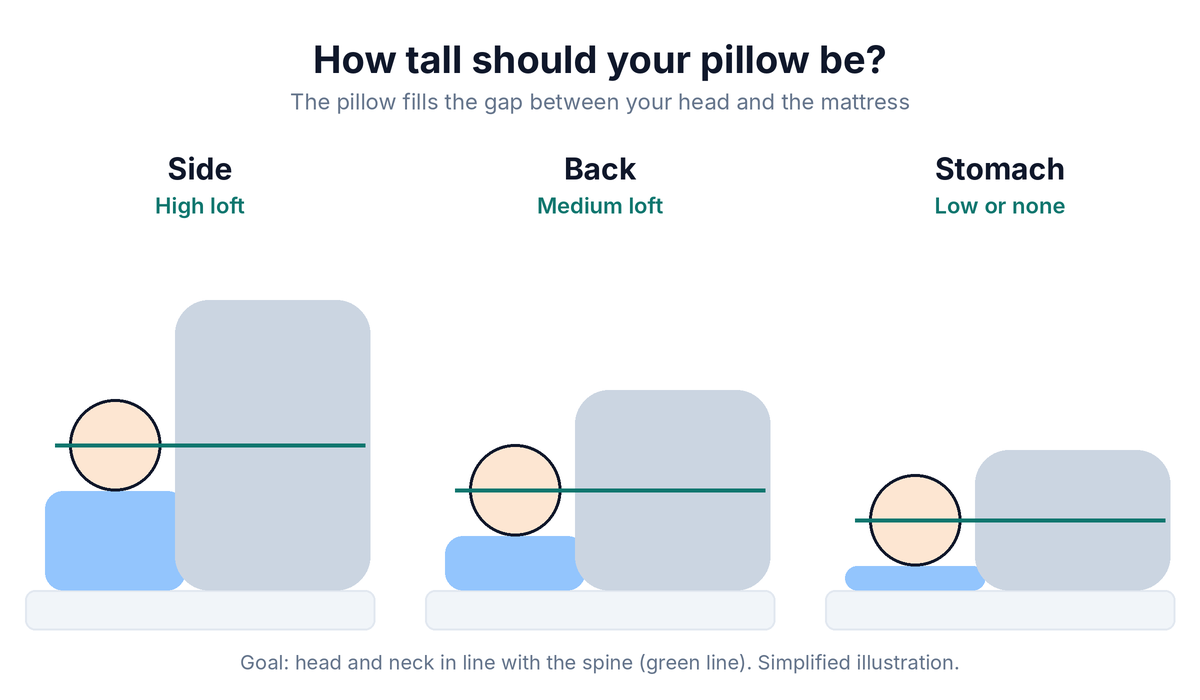
There's a better starting point: the position you sleep in. Your pillow's job is to fill the gap between your head and the mattress so your neck stays roughly in line with the rest of your spine. That gap is very different for a side sleeper than for someone who sleeps face-down.
Two words to know: loft and firmness
Loft is simply how tall the pillow is when nobody is lying on it. Firmness is how much it squishes down once your head is on it. A tall pillow that's very soft can end up feeling medium-height in practice, so it helps to think about both together.
Body size matters too. A heavier head and broader shoulders compress a pillow more, so larger sleepers often need a little more loft than the "standard" advice suggests.
Side sleepers
Lying on your side creates the biggest space to fill: the distance from your ear down to the outside of your shoulder. A flat pillow lets your head tip down toward the mattress, which is why side sleepers so often end up hugging or folding their pillow.
What usually works:
- High loft, with enough height to keep your nose roughly in line with the center of your chest.
- Medium-firm to firm, so it doesn't collapse halfway through the night.
- A contoured or shaped design can help if you like to tuck an arm under the pillow, since it leaves room for your shoulder.
Back sleepers
On your back, the gap is smaller: just the natural curve behind your neck. Too tall a pillow pushes your chin toward your chest. Too flat, and your head tilts back.
- Medium loft. The Sleep Foundation describes mid-loft pillows as roughly 3 to 5 inches tall.
- Medium firmness, or a pillow with a slightly raised edge that supports the curve of the neck.
- Some back sleepers also like a small pillow under the knees, which takes a bit of pressure off the lower back.
Stomach sleepers
Sleeping face-down means your head is already turned to one side. Adding a thick pillow lifts it even further and bends the neck backward.
- Low loft: the thinner the better. Some stomach sleepers skip the head pillow entirely.
- Soft, so your head can sink in instead of being propped up.
- A thin pillow under the hips can help keep the lower back from sagging into the mattress.
Combination sleepers
Most people move several times a night. If you fall asleep on your back and wake up on your side, you need something that works reasonably well in both positions.
- Adjustable fill (shredded foam or fiber you can add or remove) lets you tune the height over a few nights.
- Medium loft and medium firmness is the safest middle ground.
- Shaped pillows with a lower center and higher sides give you two heights in one: center for your back, edges for your side.
| Sleep position | Loft (height) | Firmness | Look for |
|---|---|---|---|
| Side | High | Medium-firm to firm | Room for your shoulder or arm |
| Back | Medium (about 3–5 in) | Medium | Support for the curve of the neck |
| Stomach | Low, or none | Soft | A thin pillow; optional pillow under hips |
| Combination | Medium or adjustable | Medium | Adjustable fill or a shaped design |
A quick test you can do at home
- Lie down in the position you usually fall asleep in, with your current pillow.
- Ask someone to look at you from the side (or take a photo with a timer).
- Your head, neck and upper back should form a fairly straight line, not tipped up or sagging down.
- If your head tilts down toward the mattress, you need more loft. If it's pushed up, you need less.
When the pillow isn't the problem
A pillow can only do so much. A sagging mattress, a bedroom that's too warm, or ongoing neck or shoulder pain can all affect how you sleep. If you're dealing with persistent pain, numbness or a sleep problem that doesn't improve, it's worth talking to a doctor or physical therapist rather than buying pillow after pillow.
This article is for general information only and isn't medical advice. If you have ongoing pain or sleep problems, talk to a healthcare professional.