Sleep Guide
How Often Should You Replace Your Pillow? 6 Signs It's Time
Pillows don't come with an expiration date, but they do wear out. Here's how long each type usually lasts and the signs yours is done.
Published · 5 min read
Pillows wear out slowly, which is exactly why most of us keep them too long. There's no single moment when a pillow "breaks." It just gets a little flatter, a little lumpier and a little more yellow every month until you're folding it in half to get comfortable.
As a general rule, the Sleep Foundation says most pillows need replacing after about one to two years of regular use. But the real answer depends on what your pillow is made of and how it's holding up.
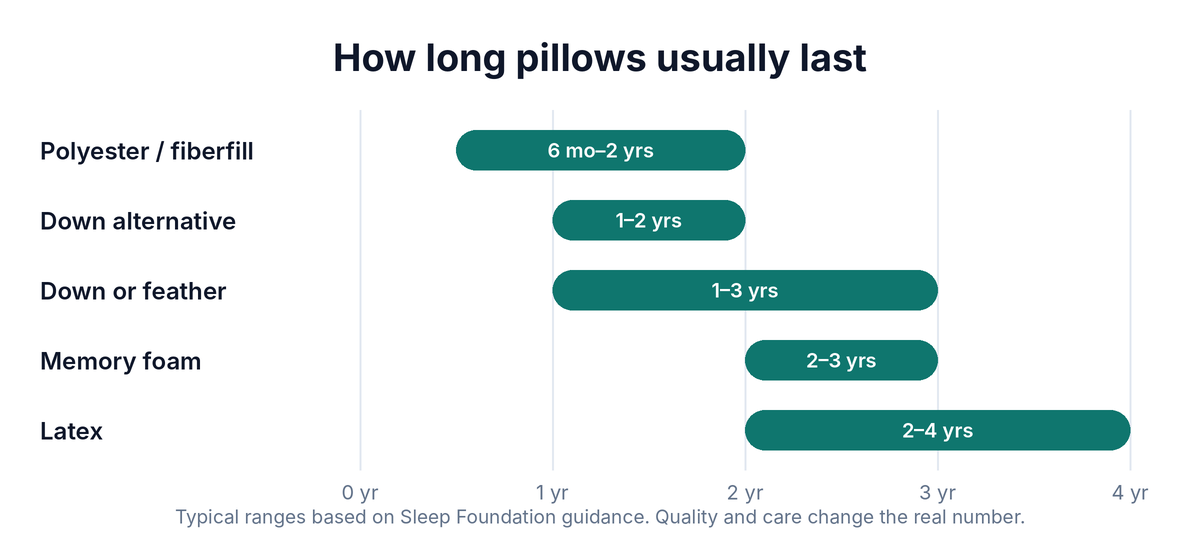
How long pillows last, by material
These are typical ranges based on Sleep Foundation guidance. Higher-quality, denser materials usually sit at the long end.
| Pillow type | Typical lifespan |
|---|---|
| Polyester / fiberfill | 6 months to 2 years |
| Down alternative | About 1 to 2 years |
| Down or feather | 1 to 3 years |
| Memory foam | 2 to 3 years |
| Latex | 2 to 4 years |
| Buckwheat | Replace the hulls about every 3 years |
6 signs it's time for a new pillow
1. You wake up stiff or sore
If your neck or shoulders feel tight in the morning and loosen up during the day, your pillow may no longer be holding your head at the right height.
2. You keep folding, stacking or punching it
A good pillow should work the way it is. If you need to double it over or add a second one to get comfortable, the fill has lost its support.
3. It's flat, saggy or lumpy
Fiber and feather fills clump together over time, leaving thin spots. Foam can develop a permanent dent where your head usually rests.
4. It fails the fold test
For down, feather and fiberfill pillows: fold the pillow in half and let go. If it stays folded instead of springing back open, it's done. (This test doesn't work for solid foam, which doesn't fold easily.)
5. It has yellow stains or a smell that won't wash out
Every night a pillow absorbs a little sweat, skin oil and moisture. Over time that shows up as yellowing and a stale smell that cleaning can't fix.
6. Your allergies seem worse at night
Older pillows collect dust and debris. If you're stuffier in bed than during the day, an old pillow is one of the things worth ruling out.
How to make your next pillow last longer
- Use a pillow protector. A zippered, washable protector under the pillowcase is the cheapest way to extend a pillow's life.
- Change pillowcases weekly, or whenever you wash your sheets.
- Clean the pillow itself a few times a year, following the care label. Many fiber and down pillows can go in the washer; most solid memory foam pillows can't.
- Let it breathe. Fluff fiber pillows daily and air pillows out on a dry, sunny day now and then.
What to do with an old pillow
Old pillows usually can't be donated for reuse, but they're still useful. Many animal shelters accept them for bedding (call first), and they work well as stuffing for floor cushions or pet beds. Some textile recycling programs also take pillows; check what's available in your area.
This article is for general information only and isn't medical advice. If you have ongoing pain or sleep problems, talk to a healthcare professional.